Telephone Solution
Lexatel designs and implements telephone solutions based on IP telephony for its outbound call centre clients. Our services are provided from our cloud infrastructure, which allows our clients to avoid investment in hardware or software and they can access our services on a pay per use or a subscription basis. This provides a low cost start up option for new businesses, keeps cost low and variable for existing customers and lets them still enjoy all the advanced features of the solution.
Below is a list of features. For more detailed explanation or a more extensive list, please contact us and we will be happy to provide additional information.
Basic Features
Advanced Features
Key Benefits
Low cost to start up. You only need to start with exactly the amount of equipment (phones, switch, load balancer, Quality of Service device) you need.
Low cost to install. Most modern offices and serviced offices already have data networks (structured cabling) installed. VoIP phones can be plugged into this network and as long as you have a suitable internet connection you can use the service.
Future proof. Our solution is future proof because of its modular nature and use of universal-standards. You can forget about having to buy another expensive phone system that will go out of date over the coming years.
Scalability. You solution grows with your business needs and what is more important it does not require step investments in order to grow.
Flexibility. If your operation is based in more than one location we can implement a solution that will create one telephony solution for the whole operation. This will mean that employees will be able to dial everyone in the business on their internal extension numbers, at no cost, all the functionally will be available to everyone giving the business more flexibility e.g. If you had a sales operation in Madrid, but all potential sales had to be complied by the compliance officer in London, the sales staff in Madrid could internally transfer the sales calls to the compliance officer in London seamlessly.
No worry about maintenance. Since the equipment is not physically located in your office you do not have to worry about technical maintenance or associated costs (such as power supply, air-conditioning, system checks, etc.)
Linear behaviour of costs. Adding new extensions or new functionality to the system generates only very small incremental costs. If you owned the telephone system (PBX) at your office, you will very often face a situation where you have to buy an expensive module for 64 persons, while in fact you only need 5.
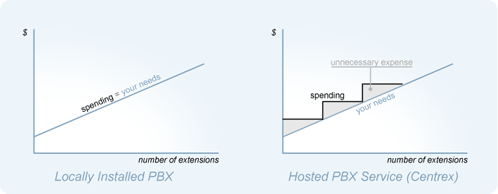
Unlike typical investments in fixed assets, the hosted model allows you to adjust your expenses for business telephony applications exactly to your needs.
Lower cost by avoiding national or international call charges. Calls between your "internal" extensions are free of charge even if your phones are in different countries.